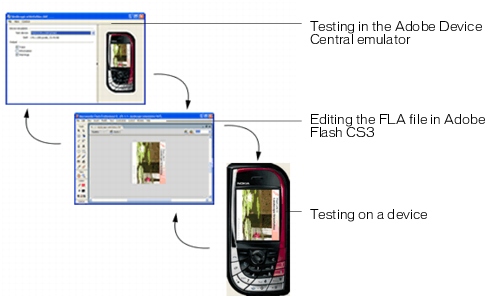
Workflow for authoring Flash Lite applications
Creating Flash Lite content is an iterative process that involves the following steps:
Identify your target devices and Flash Lite content type Different devices have different screen sizes, support different audio formats, and have different screen color depths, among other factors. These factors may influence your application's design or implementation.
In addition, different devices support different Flash Lite content types, such as screen savers, stand-alone applications, or animated ring tones. The content type for which you are developing also determines the features that are available to your application. For more information, see About Flash Lite content types.
Create your application in Flash and test in Adobe Device Central Adobe Flash CS3 Professional includes an emulator on Adobe Device Central that lets you test your application without having to transfer it to a device. You use the emulator to refine your application design and fix any problems before you test it on a mobile device.
Test the application on your target device or devices This step is important because the Adobe Device Central emulator doesn't emulate all aspects of the target device, such as its processor speed, color depth, or network latency. For example, an animation that runs smoothly on the emulator might not run as quickly on the device because of its slower processor speed, or a color gradient that appears smooth in the emulator may appear banded when viewed on the actual device. After you test your application on a device, you may find that you need to refine the application's design in the Flash authoring tool.
The following illustration shows the iterative development and testing process: