

Radial Shadow effect
The Radial Shadow effect creates a shadow from a point light source over the clip it’s applied to, rather than from an infinite light source (as with the Drop Shadow effect). The shadow is cast from the alpha channel of the source clip, allowing the color of that clip to influence the color of the shadow as light passes through semi‑transparent areas.
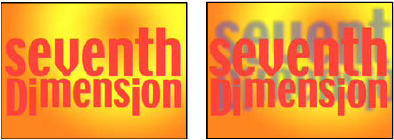
Original (left), and with effect applied (right)
- Shadow Color
-
The color of the shadow.
Note: The colors of the clip may override the Shadow Color if you choose Glass Edges from the Render control menu. See the Render and Color Influence controls for more information.
- Opacity
- The opacity of the shadow.
- Light Source
-
The location of the point light source.
 Copy
and paste position keyframes from another effect’s control point
(for example, Lens Flare) to quickly create a shadow that matches
another effect’s light source.
Copy
and paste position keyframes from another effect’s control point
(for example, Lens Flare) to quickly create a shadow that matches
another effect’s light source. - Projection Distance
- The distance from the clip to the surface on which the shadow falls. The shadow appears larger as this value increases.
- Softness
- The softness of the shadow’s edges.
- Render
-
The type of shadow:
- Regular
- Creates a shadow based on the Shadow Color and Opacity values, regardless of semi‑transparent pixels in the clip. (If Regular is chosen, the Color Influence control is disabled.)
- Glass Edge
- Creates a colored shadow based on the color and opacity of the clip. If the clip contains semi‑transparent pixels, the shadow uses both the color and transparency of the clip, creating the appearance, for example, of sun shining through stained glass.
The more transparent the pixels in the clip are, the closer the shadow color matches the colors of the clip. If the clip contains no semi‑transparent pixels, Glass Edge has little result.
Note: Anti‑aliased edges produce colors in a shadow edge if you choose Glass Edge, even if the clip is fully opaque. The clip’s colors shine through these anti‑aliased edges, and the Shadow Color fills the center of the shadow. - Color Influence
- The fraction of the clip’s color values that appear in the shadow. At 100%, the shadow takes on the color of any semi‑transparent pixels in the clip. If the clip contains no semi‑transparent pixels, Color Influence has little result, and the Shadow Color value determines the shadow’s color. Decreasing the Color Influence value blends the colors of the clip in the shadow with the Shadow Color. Increasing Color Influence reduces the influence of the Shadow Color.
- Shadow Only
- Select to render only the shadow.
- Resize Layer
- Select to allow the shadow to extend beyond the clip’s original boundaries.