

Echo effect
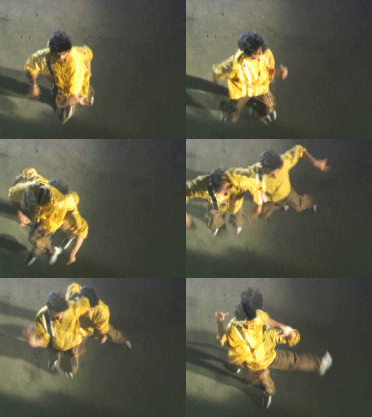
The Echo effect combines frames from different times in a layer. The Echo effect has a variety of uses, from a simple visual echo to streaking and smearing effects. The results of this effect are visible only if there is change across time in the layer, such as motion.
Note: A layer’s masks and any previously applied effects are ignored
by the Echo effect. To echo the frames of a layer with its masks
and effects, precompose the layer before applying the Echo effect.
This effect works with 8-bpc, 16-bpc, and 32-bpc color.
Echo effect
- Echo Time (seconds)
- The time, in seconds, between echoes. Negative values create echoes from previous frames; positive values create echoes from upcoming frames.
- Number of Echoes
- The number of echoes. For example, if the value is 2, the result is a combination of three frames: the current time, the current time + Echo Time, and the current time + (2 * Echo Time).
- Starting Intensity
- The opacity of the first image in the echo sequence.
- Decay
- The ratio of the opacity of an echo to the opacity of the echo preceding it in the echo sequence. For example, if Decay is 0.5, then the opacity of the first echo is half of the Starting Intensity; the second echo is half of that, or one quarter of the Starting Intensity.
- Echo Operator
-
The blending operation used to combine the echoes.
- Add
- Combines the echoes by adding their pixel values. If the starting intensity is too high, this mode can quickly overload and produce streaks of white.
- Maximum
- Combines the echoes by taking the maximum pixel values from all of the echoes.
- Minimum
- Combines the echoes by taking the minimum pixel values from all of the echoes.
- Screen
- Emulates combining the echoes by sandwiching them optically. This mode is similar to Add, but it won’t overload as quickly.
- Composite In Back
- Uses the echoes’ alpha channels to composite them back to front.
- Composite In Front
- Uses the echoes’ alpha channels to composite them front to back.
- Blend
- Averages the echoes.