

Gradient Wipe effect
The Gradient Wipe effect causes pixels in the layer to become transparent based on the luminance values of corresponding pixels in another layer, called the gradient layer. Dark pixels in the gradient layer cause the corresponding pixels to become transparent at a lower Transition Completion value. For example, a simple grayscale gradient layer that goes from black on the left to white on the right causes the underlying layer to be revealed from left to right as Transition Completion increases.
This effect works with 8-bpc and 16-bpc color.
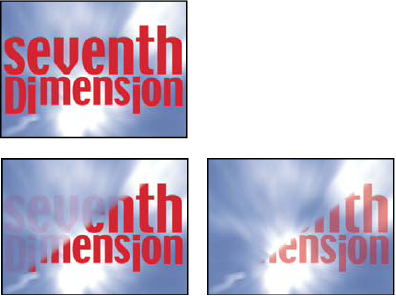
The gradient layer can be a still image or a moving image. The gradient layer must be in the same composition as the layer to which you apply Gradient Wipe.
You can create gradient layers in many ways, such as using the Ramp effect or creating them in Photoshop or Illustrator.
- Transition Softness
- The degree to which the transition is gradual for each pixel. If this value is 0%, pixels in the layer to which the effect is applied are either completely opaque or completely transparent. If this value is greater than 0%, pixels are semitransparent at the intermediate stages of the transition.
- Gradient Placement
-
How the gradient layer’s pixels are mapped to the pixels
of the layer to which the effect is applied:
- Tile Gradient
- Uses multiple tiled copies of the gradient layer.
- Center Gradient
- Uses a single instance of the gradient layer in the center of the layer.
- Stretch Gradient To Fit
- Resizes the gradient layer horizontally and vertically to fit the entire area of the layer.
- Invert Gradient
- Inverts the gradient layer’s influence; lighter pixels in the gradient layer create transparency at a lower Transition Completion value than do darker pixels.