

curveTo (MovieClip.curveTo method)
public curveTo(controlX:Number, controlY:Number, anchorX:Number, anchorY:Number) : Void
Draws a curve using the current line style from the current drawing position to (anchorX, anchorY) using the control point that ((controlX, controlY) specifies. The current drawing position is then set to (anchorX, anchorY). If the movie clip you are drawing in contains content created with the Flash drawing tools, calls to curveTo() are drawn underneath this content. If you call the curveTo() method before any calls to the moveTo() method, the current drawing position defaults to (0,0). If any of the parameters are missing, this method fails and the current drawing position is not changed.
You can extend the methods and event handlers of the MovieClip class by creating a subclass.
controlX:Number - An integer that specifies the horizontal position of the control point relative to the registration point of the parent movie clip.
controlY:Number - An integer that specifies the vertical position of the control point relative to the registration point of the parent movie clip.
anchorX:Number - An integer that specifies the horizontal position of the next anchor point relative to the registration point of the parent movie clip.
anchorY:Number - An integer that specifies the vertical position of the next anchor point relative to the registration point of the parent movie clip.
The following example draws a nearly circular curve with a solid blue hairline stroke and a solid red fill:
this.createEmptyMovieClip("circle_mc", 1);
with (circle_mc) {
    lineStyle(0, 0x0000FF, 100);
    beginFill(0xFF0000);
    moveTo(0, 100);
    curveTo(0,200,100,200);
    curveTo(200,200,200,100);
    curveTo(200,0,100,0);
    curveTo(0,0,0,100);
    endFill();
}
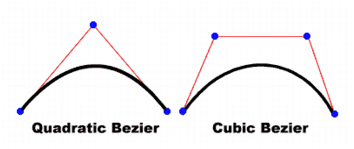
The curve drawn in this example is a quadratic Bezier curve. Quadratic Bezier curves consist of two anchor points and a control point. The curve interpolates the two anchor points, and curves toward the control point.
The following script uses the curveTo() method and the Math class to create a circle:
this.createEmptyMovieClip("circle2_mc", 2);
circle2_mc.lineStyle(0, 0x000000);
drawCircle(circle2_mc, 100, 100, 100);
function drawCircle(mc:MovieClip, x:Number, y:Number, r:Number):Void {
    mc.moveTo(x+r, y);
    mc.curveTo(r+x, Math.tan(Math.PI/8)*r+y, Math.sin(Math.PI/4)*r+x,
Math.sin(Math.PI/4)*r+y);
    mc.curveTo(Math.tan(Math.PI/8)*r+x, r+y, x, '+y);
    mc.curveTo(-Math.tan(Math.PI/8)*r+x, r+y, -Math.sin(Math.PI/4)*r+x,
Math.sin(Math.PI/4)*r+y);
    mc.curveTo(-r+x, Math.tan(Math.PI/8)*r+y, -r+x, y);
    mc.curveTo(-r+x, -Math.tan(Math.PI/8)*r+y, -Math.sin(Math.PI/4)*r+x,
-Math.sin(Math.PI/4)*r+y);
    mc.curveTo(-Math.tan(Math.PI/8)*r+x, -r+y, x, -r+y);
    mc.curveTo(Math.tan(Math.PI/8)*r+x, -r+y, Math.sin(Math.PI/4)*r+x,
-Math.sin(Math.PI/4)*r+y);
    mc.curveTo(r+x, -Math.tan(Math.PI/8)*r+y, r+x, y);
}
An example is also in the drawingapi.fla file in the ActionScript samples folder at www.adobe.com/go/learn_fl_samples. Download and decompress the .zip file and navigate to the folder for your version of ActionScript to access the sample.
beginFill (MovieClip.beginFill method), createEmptyMovieClip (MovieClip.createEmptyMovieClip method), endFill (MovieClip.endFill method), lineStyle (MovieClip.lineStyle method), lineTo (MovieClip.lineTo method), moveTo (MovieClip.moveTo method), Math