|
|||||||
|
|||||||








|
Net profit margin represents how well your company has been generating profits.
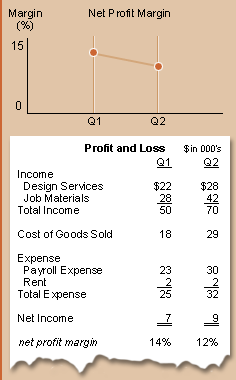
It shows you what percentage of each sales dollar ends up as profit. If expenses exceed revenues for a period, the result is a net loss. The graph at right shows your net profit margin for the current quarter and three prior quarters. How does it help to know this? See profitability gains and declinesNet profit margin allows you to compare quarters that have very different results in absolute dollar terms. Income, expense, and profit all vary from quarter to quarter. Since your Profit & Loss report is always different, it can be hard to know whether profitability is improving. You might reasonably assume that an increase in sales or net income means you're doing better - but that's not always the case. An increase in the bottom line may look better, but it's not if expenses are growing even faster.You can use this tool to see whether profitability is improving and track how the relationship between income and expenses changes over time.
What results are satisfactory?
A profit margin between 5 and 10% is common in many industries, but this range can vary widely. Some companies will find a lower profit margin acceptable when accompanied by a high sales volume. Companies with low overhead costs generally enjoy a higher profit margin. Find out what's right for your business by talking with your accountant. What business activities affect my results? Anything that impacts your income or expenses can affect your profit margin. Decisions about pricing, purchasing, hiring, and discounts all influence this number. Consider the impact on overall financial performance when making decisions like these. Profit margin can also vary with periodic fluctuations in the business cycle. A temporary increase or decrease in sales volume will affect profitability, especially for companies with lots of fixed costs. Seasonal businesses are likely to experience seasonal changes in profit margin, even when fundamental business practices remain constant.
How can I gain better control over these results?
Look at today's profit margin in comparison to prior quarters. Is it fairly consistent, or have there been fluctuations or sudden changes? Pay attention to trends. If margins are changing, determine why by asking specific questions about recent business activity. For instance:
Conduct a financial analysis of your business on a regular basis, checking profit margin and other performance ratios. This way you can recognize changes early, and find out what's making your margins improve or decline. The sooner you uncover the events and developments that increase or decrease your profit, the more control you have over influencing them to benefit your business.
Is Larry's Landscaping improving profitability?
It seems like it: the company had only $7,000 of net income in the first quarter and $9,000 in the second. But the net profit margin tells a different story. The margin fell by 2% in the second quarter, because expenses grew faster than income. What happened? During the second quarter, a supplier increased prices by a small amount. Larry didn't want to alienate customers, so he chose not to raise his own prices. But the small increase in Cost of Goods Sold accumulated enough to affect profitability. Also, Larry's administrative assistant quit unexpectedly last quarter, and he had to hire an expensive temporary worker to cover the loss. These two events contributed to a decline in profitability. Next month, Larry will step up his efforts to hire a full time assistant. He is also considering raising prices in order to cover the supplier's price increase. He's planning for the future too. He just got a new toll-free number, and he's expecting an increase in telephone expenses. When he raises prices, he'll take this into account.
Where does this number come from?
Net profit margin is an analysis of the Profit & Loss report.
All Income includes the Total Income and Total Other Income accounts. All Expense (displayed with the graph) includes Total COGS, Total Expense, and Total Other Expense. Why does the calculation matter? There is no single right way to calculate profit margin. The calculation can vary slightly depending on the question the ratio is meant to answer. For instance, when calculating pre-tax profit margin, tax expense accounts are excluded. This tool reflects your entire financial picture by including all recorded income and expenses. QuickBooks uses the accrual method to calculate net profit margin. If you operate on cash basis, your reports may differ. If so, you can view accrual reports by selecting Accrual from the Modify Reports window. Whether analyzing your financial condition, talking to your accountant, or comparing your margins to industry benchmarks, knowing what your profitability results represent gives you a more accurate picture of company performance. |
|




 |
 |
 |
|
 |
|