|
|||||||
|
|||||||








|
Working capital and the current ratio measure the liquidity of your business - its
ability to meet short-term debt with current assets.
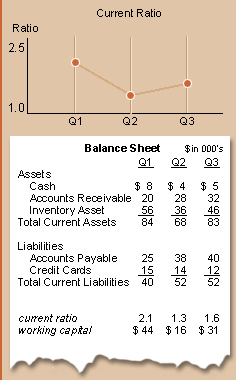
Together, these are two of the most common measures of financial strength. The current ratio shows whether a company has sufficient access to cash to continue operations after paying off current liabilities. Working capital is the dollar amount by which current assets exceed current liabilities. The graph at right shows you how many dollars of current assets you have to cover each dollar of current liabilities. For example, a result of 2 means there are $2 of current assets for every $1 of current liabilities. How does it help to know this? Respond to emergenciesIt's important to maintain a margin of safety in liquid assets to handle potential emergencies. Inventory shrinkage, uncollectable accounts, or a debt that suddenly comes due may require you to rely more heavily on your current assets. Keeping a cushion helps you weather the inherent uncertainties of running a business.Access investment, growth, and expansion opportunitiesIn addition, loans are frequently tied to minimum working capital and current ratio requirements. With a sound liquidity position, your company's chances of obtaining a loan increase.
What results are satisfactory?
A current ratio of 2.0 is considered good for most industries. A higher ratio is generally an indication of a stronger financial position, and may mean there is cash available for the owner to withdraw. But there are exceptions; a high ratio can sometimes mask hidden financial problems. For instance:
Any of these conditions may reduce the productive capacity of the business or indicate financial trouble. It's important to look at why your current ratio is high or low, as well as looking at the number itself. A low current ratio can also mean trouble. A ratio of 1.0 means that for every dollar owed, there is exactly one dollar available to pay it. This leaves you without any cushion - a risky situation indeed. A decline in the current ratio over time can be problematic as well. It may indicate that the company will not be able to meet its debt when that debt comes due. Like the current ratio, a higher working capital figure generally indicates a stronger financial position.
What business activities affect my results?
Anything that increases or decreases current assets or current liabilities can affect working capital and the current ratio.
How can I gain better control over these results? Are Total Current Assets or Total Current Liabilities increasing? Decreasing? What caused the change? If you want to improve your current ratio, these things may help:
Can Larry's Landscaping handle a financial crisis?
Larry's current ratio is just fine in the first quarter, but it takes a big dip in the second quarter. Luckily, it improves in quarter three… or does it? In the second quarter, Larry falls behind on paying his bills. He's a little low on cash, so he negotiates extended terms with some of his larger suppliers. With relief, he turns his attention back to providing landscaping services. Unfortunately, he's so busy landscaping that he doesn't make time to collect what he's owed. Accounts Receivable starts to grow. The current ratio swings back up in quarter three, but it's largely due to the increase in A/R and Inventory. Larry is building up inventory so he can quickly and easily accept more jobs. He expects this strategy to pay off in the long run, but right now Larry is still low on cash and behind on his bills. He should halt the inventory buildup and start collecting outstanding accounts receivable, or he may run short of cash before he gets to see his long-range plan succeed.
Where do these numbers come from?
Working capital and the current ratio analyze the Balance Sheet. Like the Balance Sheet, they show a snapshot of your business at a specific point in time.
Total Current Assets includes the Bank, A/R, Inventory, and Other Current Asset accounts. Total Current Liabilities includes Credit Card, A/P, and Other Current Liabilities. Why does the calculation matter? Your current ratio will accurately reflect your financial position if you enter data into QuickBooks as follows. If you enter data differently, your current ratio may be off.
|
|





 |
 |
 |
|
 |
|