|
|||||||
|
|||||||








|
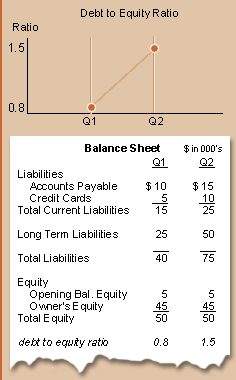
The debt to equity ratio reveals how much of your business is funded by creditors.
For each dollar of assets contributed by owners (equity), creditors contributed the amounts shown on the graph (debt). This shows the degree to which the business relies on borrowed money, versus the degree to which it is supported by owners' investments. How does it help to know this? Access investment, growth, & expansion opportunitiesBankers and many other lenders look for a satisfactory debt to equity ratio before making a loan. Some loan contracts stipulate a maximum debt to equity ratio. You may increase your chances of getting a loan by keeping this ratio strong.Manage financial riskKnowing your debt to equity ratio can help you keep your debt within reasonable limits, based on industry norms and your level of tolerance for risk and indebtedness.Plan for the futureThe amount by which your business can realistically increase the debt to equity ratio is known as "borrowing capacity." Use knowledge about your borrowing capacity to plan for future financing needs.Management tip: preserve some borrowing capacity for unforeseen opportunities or emergencies.
What results are satisfactory?
A ratio of 2:1 is often considered reasonable, but this benchmark varies widely by industry. Your accountant can help you identify a debt to equity ratio specific to your business. What the bankers wantCreditors prefer a relatively low debt to equity ratio. Lower ratios typically indicate that the business is well within its borrowing capacity and has the ability to meet new loan payments. A low ratio also means a larger equity stake in the business. Creditors may use equity as collateral, or rely on the owners' personal stake in the business to provide an incentive to make it succeed.What you wantOwners may want the ratio to be somewhat higher. As long as the return on borrowed money exceeds its interest cost, owners benefit from a loan. This creates an incentive to take advantage of debt financing as much as possible.However, business owners also have a responsibility to manage financial risk. A high debt to equity ratio may indicate the business is overextended on credit, making it difficult to meet payments or obtain further loans. This is an especially vulnerable situation for companies with cash problems. A low debt to equity ratio means the company is better able to handle its payment obligations. A lower ratio also indicates more borrowing capacity, and therefore greater financial flexibility.
What business activities affect my results?
Anything that changes debt or equity can affect this ratio. This includes:
How can I gain better control over these results? Pay attention to the decisions that increase or decrease debt or equity. Decisions about partnerships and business structure, debt financing, and how owners are paid can all impact this ratio. If you think your ratio is too high, you can try the following:
Is Larry's Landscaping overextended on credit?
Larry and his accountant have decided on a maximum debt to equity ratio of $2.00 of debt for every $1.00 of equity, or 2:1. This maximum is fairly common in the landscaping industry. In the second quarter, Larry took out a loan for new equipment. He left a 0.5 cushion of borrowing capacity, in case of an emergency. He also wants to preserve some borrowing capacity because he is expecting to need another loan in about 6 months, when he plans to make some repairs to his office building.
Where do these numbers come from?
The debt to equity ratio is an analysis of the Balance Sheet. Like the Balance Sheet,
this ratio shows a snapshot of the business at one point in time.
Total Liabilities includes all near-term and future liabilities: Credit Cards, A/P, Other Current Liability, and Long-Term Liability accounts. Equity includes all equity accounts: Opening Balance Equity, Owner's Equity, Retained Earnings, and Net Income. Why does the calculation matter? There are many different ways to enter data into QuickBooks. The debt to equity ratio will accurately reflect your financial position if you use:
|
|




 |
 |
 |
|
 |
|