

About interlaced and noninterlaced video
Interlacing is a technique developed for transmitting standard-resolution television signals using limited bandwidth. In an interlaced system, only half the number of horizontal lines for each frame of video are transmitted at a time. But because of the speed of transmission, the afterglow inherent in cathode ray tubes, and the persistence of vision, the viewer perceives each frame in full resolution. All of the analog television standards use interlacing. Digital television standards include both interlaced and noninterlaced varieties. Typically, interlaced signals are generated from interlaced scanning while noninterlaced signals are generated from progressive scanning.
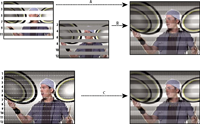
- A.
- For interlaced video, entire upper field is drawn to screen first, from top to bottom, in one pass.
- B.
- Next, entire lower field is drawn to screen, from top to bottom, in one pass.
- C.
- For noninterlaced video, entire frame is drawn to screen, from top to bottom, in one pass.
Noninterlaced video frames aren’t separated into fields. A progressive‑scan monitor displays a noninterlaced video frame by drawing all the horizontal lines, from top to bottom, in one pass. Computer monitors are almost all progressive‑scan monitors, and most video displayed on computer monitors is noninterlaced.
The terms progressive and noninterlaced are thus closely related and are often used interchangeably, but progressive refers to the recording or drawing of the scan lines by a camera or monitor, whereas noninterlaced refers to the fact that the video data itself isn’t separated into fields. For example, it’s possible with some modern cameras to use progressive scanning to record two simultaneous fields per frame of interlaced video.