

Remove Grain effect
To remove grain or visual noise, use the Remove Grain effect. This effect uses sophisticated signal processing and statistical estimation techniques in an attempt to restore the image to how it would look without the grain or noise. While many techniques, such as applying a mild Gaussian Blur effect or the Median effect, reduce the visibility of noise in an image, the tradeoff is an unavoidable loss of sharpness and highlights. The Remove Grain effect, in contrast, differentiates fine image detail from grain and noise and preserves the image detail as much as possible.
The Remove Grain effect provides several options to precisely balance the reduction in noise and the amount of sharpness retained in the image. Additionally, the Remove Grain effect can analyze the differences between frames to further improve noise reduction and sharpness; since this process operates over time, it is called temporal filtering.
The Temporal Filtering controls of the Remove Grain effect use a statistical algorithm to blend the current frame with previous and next frames. These controls are particularly effective in removing compression artifacts from DV or video footage. Because temporal filtering works on the basis of differences between frames, it is useful only for sequences.
To properly evaluate the results of this filter, the sequence must be viewed in real time, either with a RAM preview or by viewing a movie rendered to a file.
 To increase the speed of the Remove Grain effect
preview, adjust the Remove Grain controls in order in the Effect
Controls panel. Specifically, the most efficient workflow is to
find effective degraining settings first and to adjust the last
three controls last.
To increase the speed of the Remove Grain effect
preview, adjust the Remove Grain controls in order in the Effect
Controls panel. Specifically, the most efficient workflow is to
find effective degraining settings first and to adjust the last
three controls last.This effect works with 8-bpc and 16-bpc color.
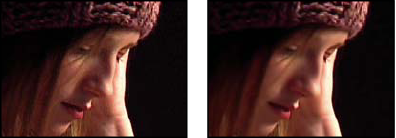
 Remove noise or grain from an image
- Adjust any of the following using the Noise Reduction
Settings controls group:
-
To adjust the overall amount of noise in the image, adjust the Noise Reduction value.
-
To adjust the amount of noise on each channel individually, adjust the Red, Green, and Blue Noise Reduction values in the Channel Noise Reduction controls.
The blue channel
often has the most pronounced grain in a chemical film-based image.
Try reducing the noise in only the blue channel to retain all image
detail in the other two channels.
-
Add temporal filtering to a sequence
- Apply the Remove Grain effect to your image.
- Place the Remove Grain preview region over the area of the image that has the most subtle changes from frame to frame or that has the most moving image detail.
- Select Enable in the Temporal Filtering controls.
- Adjust the Amount value to 100%.
- Create a RAM preview of the sequence or render it.
- If you see unwanted streaking or blurs around moving objects, reduce the Motion Sensitivity value, and then preview or render it again.
- Try the following techniques if you want to improve the
results:
-
To quickly reduce the noise of a sequence that has a lot of buzzing noise, set the Noise Reduction value to zero and the Temporal Filtering Amount to 100%, and render the sequence.
-
To speed up previews, apply temporal filtering to your sequence after all the settings for a single frame have been adjusted.
-
To retain a layer’s effects and also apply temporal filtering to it, precompose the selected layer (choose Layer > Precompose), and then apply the Remove Grain effect to that layer.
-
Sharpen an image with Unsharp Mask controls
The Remove Grain effect contains Unsharp Mask controls, which increase the contrast of edges and fine details to help restore some of the sharpness that may have been lost during the grain reduction process.
 Do any of the following:
-
Increase the Unsharp Mask controls Amount value to obtain acceptable sharpening without generating undesirable artifacts or bringing back too much grain.
-
Increase the Threshold value to remove any unwanted artifacts that resulted from the sharpening.
-
Adjust the Radius to change the area over which Unsharp Mask finds details.
-
Adjust the Noise Reduction value until the image just begins to lose sharpness; then decrease the value a little, and then apply the Unsharp Mask controls to sharpen the image.