About the Adobe dialog box
In Adobe Creative Suite 2.0 components (except for GoLive and Acrobat 7), and in InCopy CS2, you can use the Adobe dialog box when you choose the Open, Import, Export, Place, Save, or Save As commands, even if you don’t use Version Cue. In Acrobat 8, you can use the Adobe dialog box when you choose the Open, Save, or Save As commands, even if you don’t use Version Cue.
The Adobe dialog box displays additional information, including thumbnails, which make it easy to identify files. You can use the Adobe dialog box when working with both Adobe and non-Adobe files.
By default, when you choose the Open, Save, or Save As commands, the Operating System (OS) dialog box appears. To use the Adobe dialog box instead and set it as the default, click Use Adobe Dialog. Use the View menu options to customize the display. You can change back to the OS dialog box at any time by clicking Use OS Dialog.
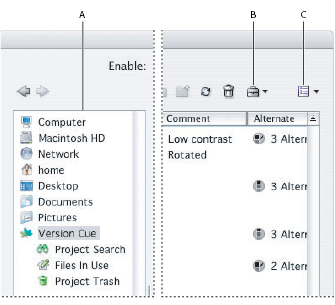
- A.
- Favorites panel
- B.
- Project Tools menu
- C.
- View menu
You can use the Adobe dialog box to accomplish these tasks:
-
Add frequently used files and folders to the Favorites panel for quick access.
-
View thumbnail images of files.
-
Determine whether a file is open in Acrobat 8 or another Adobe Creative Suite application on your computer.
-
Rename or delete files (Mac OS only).
-
View metadata about files in the Properties panel. Metadata includes author, keyword, and copyright information.
-
Access Version Cue projects and files as well as non-Version Cue files.
-
View detailed information about Version Cue projects, such as the status of individual files.
-
View and work with Version Cue versions.
-
Search for files in a Version Cue project.
-
Move Version Cue files to the Project Trash.
-
Determine which Version Cue files are in use, and who is using them.
-
Create a new Version Cue project, or connect to an existing Version Cue project.