In the previous tutorial we added sine tones together to make a complex
tone. In this chapter we will see how a very different effect can be
achieved by multiplying signals. Multiplying one wave by
another - i.e., multiplying their instantaneous amplitudes, sample
by sample - creates an effect known as ring modulation (or,
more generally, amplitude modulation). ‘Modulation’ in this
case simply means change; the amplitude of one waveform is changed
continuously by the amplitude of another.
In our example patch, we multiply two sinusoidal tones. Ring
modulation (multiplication) can be performed with any signals,
and in fact the most sonically interesting uses of ring
modulation involve complex tones. However, we'll stick to sine
tones in this example for the sake of simplicity, to allow
you to hear clearly the effects of signal multiplication.
The tutorial patch contains two cycle~ objects, and the
outlet of each one is connected to one of the inlets of
a *~ object. However, the output of one of
the cycle~ objects is first scaled by an additional *~ object,
which provides control of the over-all amplitude of the result.
(Without this, the over-all amplitude of the product of the
two cycle~ objects would always be 1.)
Tremolo
When you first open the tutorial patch, a loadbang object
initializes the frequency and amplitude of the oscillators. One
oscillator is at an audio frequency of 1000 Hz. The other
is at a sub-audio frequency of 0.1 Hz (one cycle every
ten seconds). The 1000 Hz tone is the one we hear (this is
termed the carrier oscillator), and it is modulated by
the other wave (called the modulator) such that we hear
the amplitude of the 1000 Hz tone dip to 0 whenever the 0.1 Hz
cosine goes to 0. (Twice per cycle, meaning once every five
seconds.)
Click on the ezdac~ to turn audio on and raise the
volume on the gain~ slider. You will hear the amplitude
of the 1000 Hz tone rise and fall according to the cosine
curve of the modulator, which completes one full cycle every
ten seconds. (When the modulator is negative, it inverts the
carrier, but we don't hear the difference, so the effect is
of two equivalent dips in amplitude per modulation period.)
The amplitude is equal to the product of the two waves.
Since the peak amplitude of the carrier is 1, the over-all
amplitude is equal to the amplitude of the modulator.
Drag on the number box labeled Amplitude to
adjust the sound to a comfortable level. Click on
the message box containing the number 1
to change the modulator rate.
With the modulator rate set at 1, you hear the
amplitude dip to 0 two times per second. Such a periodic
fluctuation in amplitude is known as tremolo.
(Note that this is distinct from vibrato, a term
usually used to describe a periodic fluctuation in pitch
or frequency.) The perceived rate of tremolo is equal to
two times the modulator rate, since the amplitude goes
to 0 twice per cycle. As described on the previous page,
ring modulation produces the sum and difference frequencies,
so you're actually hearing the frequencies 1001 Hz
and 999 Hz, and the 2 Hz beating due to the interference
between those two frequencies.
One at a time, message boxes containing 2 and 4.
What tremolo rates do you hear? The sound is still like
a single tone of fluctuating amplitude because the sum
and difference tones are too close in frequency for you
to separate them successfully, but can you calculate what
frequencies you're actually hearing?
Now try setting the rate of the modulator to 8 Hz, then 16 Hz.
In these cases the rate of tremolo borders on the audio
range. We can no longer hear the tremolo as distinct
fluctuations, and the tremolo just adds a unique sort
of ‘roughness’ to the sound. The sum and difference
frequencies are now far enough apart that they no longer
fuse together in our perception as a single tone, but they
still lie within what psychoacousticians call the critical
band. Within this critical band we have trouble hearing
the two separate tones as a pitch interval, presumably
because they both affect the same region of our basilar
membrane.
Sidebands
Try setting the rate of the modulator to 32 Hz, then 50 Hz.
At a modulation rate of 32 Hz, you can hear the two
tones as a pitch interval (approximately a minor second),
but the sensation of roughness persists. With a modulation
rate of 50 Hz, the sum and difference frequencies are 1050 Hz
and 950 Hz - a pitch interval almost as great as a major
second - and the roughness is mostly gone. You might also
hear the tremolo rate itself, as a tone at 100 Hz.
You can see that this type of modulation produces new
frequencies not present in the carrier and modulator
tones. These additional frequencies, on either side of
the carrier frequency, are often called sidebands.
Listen to the remaining modulation rates.
At certain modulation rates, all the sidebands are
aligned in a harmonic relationship. With a modulation
rate of 200 Hz, for example, the tremolo rate is 400 Hz
and the sum and difference frequencies are 800 Hz and 1200 Hz.
Similarly, with a modulation rate of 500 Hz, the tremolo
rate is 1000 Hz and the sum and difference frequencies
are 500 Hz and 1500 Hz. In these cases, the sidebands
fuse together more tightly as a single complex tone.
Experiment with other carrier and modulator frequencies
by typing other values into the
number box objects.
Note how different ratios of frequencies create different
harmonic (or inharmonic) sidebands.
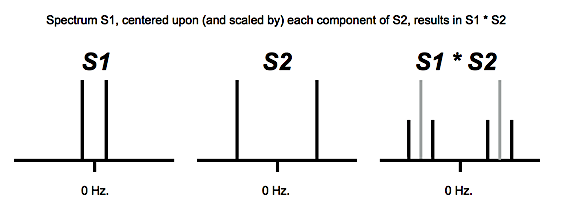
Technical detail: Multiplication of waveforms in the time
domain is equivalent to convolution of waveforms in the
frequency domain. One way to understand convolution is as the
superimposition of one spectrum on every frequency of another
spectrum. Given two spectra S1 and S2, each of which
contains many different frequencies all at different amplitudes,
make a copy of S1 at the location of every frequency in S2,
with each copy scaled by the amplitude of that particular frequency
of S2.
Since a cosine wave has equal amplitude at both positive and negative
frequencies, its spectrum contains energy (equally divided)
at both f and -f. When convolved with another cosine wave,
then, a scaled copy of (both the positive and negative frequency
components of) the one wave is centered around both the positive
and negative frequency components of the other.
Summary
Multiplication of two digital signals is comparable
to the analog audio technique known as ring modulation.
Ring modulation is a type of amplitude modulation -
changing the amplitude of one tone (termed the carrier)
with the amplitude of another tone (called the modulator).
Multiplication of signals in the time domain is equivalent to
convolution of spectra in the frequency domain.
Multiplying an audio signal by a sub-audio signal results
in regular fluctuations of amplitude known as tremolo.
Multiplication of signals creates sidebands - additional
frequencies not present in the original tones. Multiplying two
sinusoidal tones produces energy at the sum and difference
of the two frequencies. This can create beating due to
interference of waves with similar frequencies, or can
create a fused complex tone when the frequencies are harmonically
related. When two signals are multiplied, the output amplitude
is determined by the product of the carrier and modulator amplitudes.